

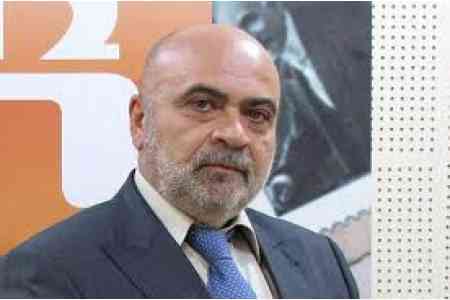
ArmInfo. Not a single public multiplex company will be profitable in 2025? This was stated by Tigran Hakobyan, Chairman of the National Television and Radio Commission (NTRC), during a press conference on February 5.
He noted that over the past 5-6 years, the National Assembly of Armenia has adopted certain amendments to the Advertising Law, which have entirely good intentions-for example, a ban on gambling advertising. Furthermore, these amendments oblige these television companies to fill 20% of their content with public- interest programming (children's, cultural, and sports), and to provide daily sign-language translation for news and children's programs. All of this, as Hakobyan noted, entails significant expenses. "On the one hand, you are reducing the advertising space through legislative initiatives, but on the other, you are increasing obligations." "In other words, the television landscape has been so purged that it's empty because companies can't make money," the head of the NCTR emphasized. He added that some television companies are still broadcasting for political purposes, as their goal is to shape the political agenda rather than accumulate profits; others rely on grants, etc. "But we are concerned that some slots may be empty in 2027-2028," Hakobyan noted.
He emphasized that the public multiplex has its own philosophy and mission, which it cannot fulfill under the current circumstances. This has led to it becoming unprofitable as a business. In this vein, Hakobyan pointed to the need to support television channels broadcasting within the public multiplex. "The main challenge we face is to support the public multiplex so that it can fulfill its mission. We need a concept for a public multiplex, but so far the state hasn't gotten around to it." "The issues are being resolved piecemeal, but the threats remain, unfortunately," he concluded.