

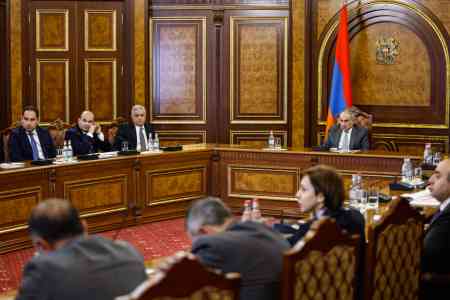
ArmInfo. The Armenian government will allocate 1.634 billion drams to fulfill financial obligations to construction organizations implementing projects under subvention programs. The decision was made at the Cabinet meeting on June 18.
As RA Minister of Territorial Administration and Infrastructure David Khudatyan noted in his speech, these programs concern 16 programs being implemented in 13 communities across the country. The funds will be transferred to regional administrations, which will then redistribute them among the communities. One program will be implemented in the Aragatsotn region, three in the Ararat region, four in the Armavir region, two in the Gegharkunik region, three in the Kotayk region, and three in the Tavush region. The minister noted that if these programs are approved, the total funding for subvention projects in 2026 will amount to 7.3 billion drams.
The rationale for the draft decision emphasizes that the adoption of the document is necessary to ensure the effective implementation of programs aimed at developing the economic and social infrastructure of the republic's communities. At meetings of the interdepartmental commission for evaluating subsidy applications, 363 subsidy programs were reviewed and approved in 2022, 273 in 2023, 242 in 2024, and 204 in 2025. These applications are primarily aimed at capital investments in communities, specifically the improvement of streets, parks, gardens, and playgrounds; the construction of water supply, sewerage, and irrigation networks; night lighting; gasification of populated areas; and the renovation of apartment buildings using energy-saving measures.
Due to adjustments to several subsidy program projects due to non-participation in announced tenders or the termination of contracts for work due to poor performance, as well as the fact that the 2025 subsidy programs were approved by the interdepartmental commission late, with the last meeting held on October 29, 2025, it became clear that most of the 2025 programs could not be completed in 2025. These programs, which are being implemented in 13 communities across the country, are now required to be completed by June 30, 2027.