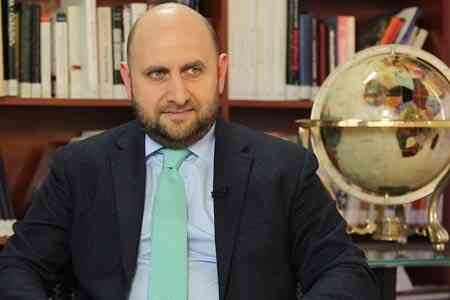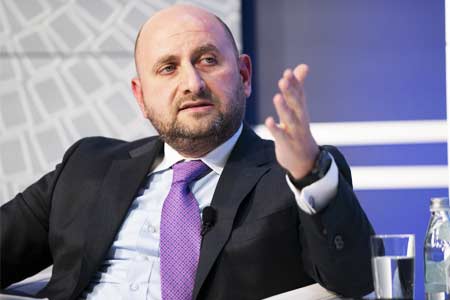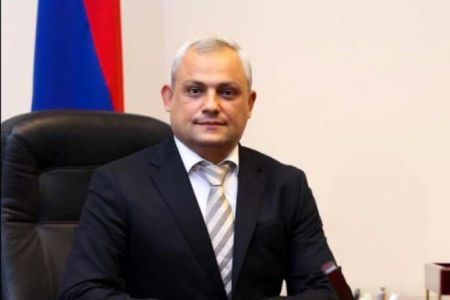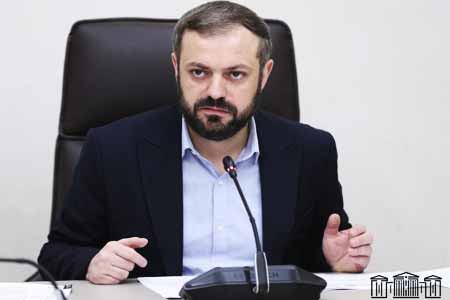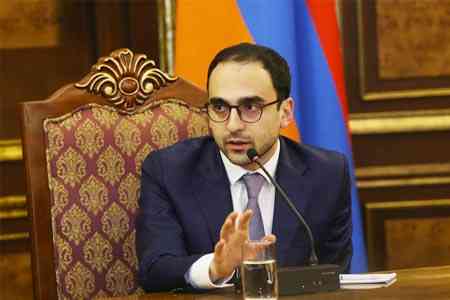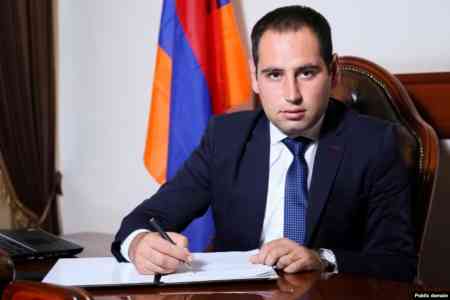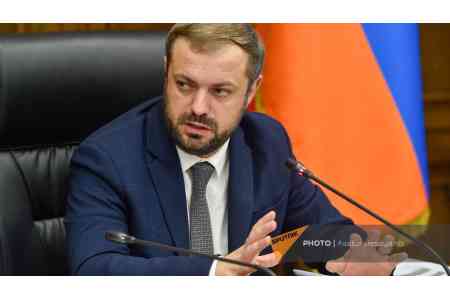


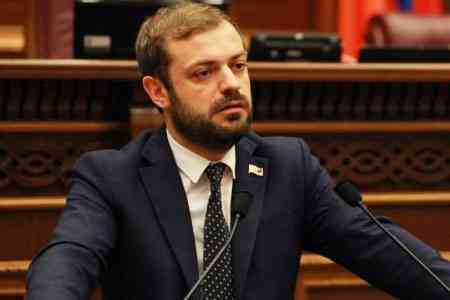
ArmInfo.Armenia highly appreciates the support of the European Union (EU), but the country does not intend to redirect its exports from the Russian to the European market. This was stated by Armenian Minister of Economy Gevorg Papoyan, amid Russia's restrictions on a number of Armenian goods and attempts to redirect exports to EU countries.
According to Papoyan, the country's goal is to diversify its exports. "Our goal, of course, is to diversify our exports. We want to export not only to Europe, but also to the Middle East, China, Asian markets, and Russia; all markets are important and target markets for us. While we greatly appreciate the EU's support, I would nevertheless like to emphasize that our goal is not to reorient ourselves from the Russian market to the European one," the Minister of Economy emphasized in an interview with Armenpress.
Papoyan went on to confirm that claims by Sergei Dankvert, head of Russia's Federal Service for Veterinary and Phytosanitary Surveillance, that Armenia ignores letters sent by his agency are baseless, and that Armenia always responds to inquiries from its Russian counterparts.
He also announced that he intends to make two visits to Russia next month and hold meetings with various partners, with whom he will discuss these issues, among other things. "Meetings are planned with two different partners. We will discuss these issues, because I believe they should be discussed at the negotiating table and that they can be resolved through coordinated work with Russia. However, I do not rule out the possibility that there are questions raised by partners that may not have yet been adequately addressed. We need to clarify these questions, bring them to the Ministry of Economy, and resolve them," Papoyan stated.
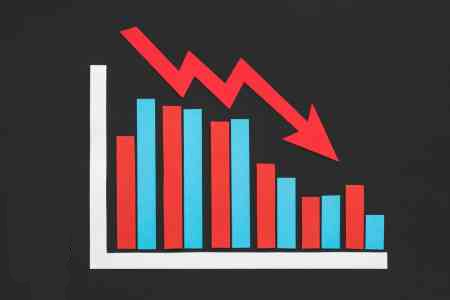
Speaking about how the Ministry of Economy is addressing the problems of Armenian businesses and exporters, given that the issues with the Russian side have not yet been resolved and exports to Russia via several routes have virtually ceased, Papoyan assured that this is happening through the diversification of the country's exports. He stated that his ministry has been able to partially resolve the situation by actively working with private businesses. However, he acknowledged that a "slight" decline in the indicators has been recorded. "From June 1 to 15 last year, Armenia's exports via specific commodity routes that are currently blocked amounted to approximately 2,300-2,400 tons, of which 90% or more went to Russia. Today, Armenia's exports via the same commodity routes are approximately 1,900 tons. Yes, there is a decrease, but not to the same extent as before. Most of the goods exported to Russia are now sent to other countries: European countries, Ukraine, Georgia, and so on, meaning the geographic reach has become broader. Yes, there are problems, but they are not on the scale expected; in fact, 70% or more is simply exported to other countries," Papoyan explained.
At the same time, the Armenian Minister of Economy expressed hope that high-level Armenian-Russian political, economic, and interpersonal ties will play a role, and the Russian market will reopen to Armenia. He stated that he cannot imagine the relationship between the two strategic partners developing differently. "Countries within an economic union may have problems, but the economic union itself should help resolve them. Our task, ultimately, is to find suitable formulas with our Russian partners and, within this framework, propose solutions to resume our exports, because we also agree that high-quality products should be exported from Armenia to friendly countries and, in general, to all destinations," Papoyan concluded.
As a reminder, on May 15, Sergey Dankvert, head of Rosselkhoznadzor, held talks with Tigran Petrosyan, head of the Food Safety Inspectorate of Armenia. The parties discussed cooperation between the competent authorities of the two countries and compliance with requirements for the supply of Armenian plant and livestock products to the Russian market. At the request of the Armenian side, Rosselkhoznadzor (Rosselkhoznadzor) inspected the facilities whose shipments to Russia had been suspended due to the suspected import of counterfeit fish products allegedly of European origin. Effective June 12, Rosselkhoznadzor restricted the import of all quarantine products from Armenia and their transit through Russia to other EAEU countries. On May 22, Russia imposed restrictions on the import of Armenian flowers, and on fruit and vegetable products, effective May 20. Russia also restricted the import of mineral water, cognac, and wine. Armenian authorities and observers attribute Moscow's actions not only to sanitary concerns but also to the sharp deterioration of relations amid the Armenian Prime Minister's policy of rapprochement with the EU and the US. Notably, the EU subsequently stated its readiness to provide Yerevan with financial assistance and to establish preferential trade conditions for Armenia.